
Claude Skills: What They Are and How to Use Them to Raise the Standard of AI Work in Your Business
By Sarah Williams, Founder of Leading Culture | Business Growth Strategist
Think about what happens when you hire someone exceptional. You give them a job description, maybe a few onboarding documents, and then you leave them to figure out the rest. And they're good, but they're not quite producing work at the standard you had in your head. Not because they're incapable. Because they don't know your standard yet. They haven't absorbed how you think, how you communicate, what good looks like in your world.
That's exactly what most people are doing with AI.
They open Claude (or whatever tool they're using), type a prompt, and wonder why the output doesn't quite feel right. The answer, almost always, is that they skipped the induction.
Skills are the induction.
So what is a skill, exactly?
A skill is a set of instructions you give Claude that teaches it something specific about how to work with you. Your writing style. Your brand. Your clients. Your business. Instead of explaining yourself every time you open a new conversation, you build the context once and Claude carries it into every session.
Think of it as institutional knowledge, captured.
Skills are just text files, which means they're not magic and they're not complicated. What makes them powerful is the quality of what goes into them. A vague skill produces vague results.
✨ A well-built skill that clearly defines what good looks like in your business produces work that actually meets your standard.
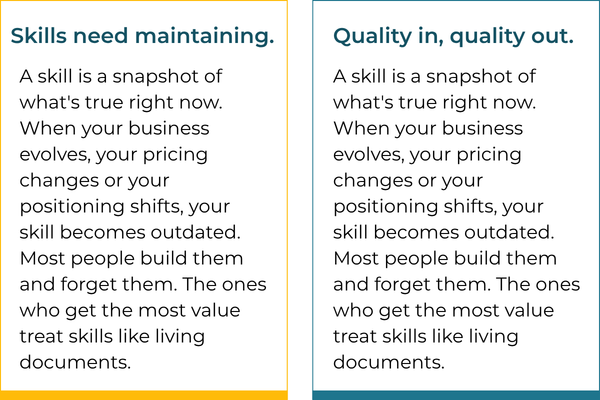
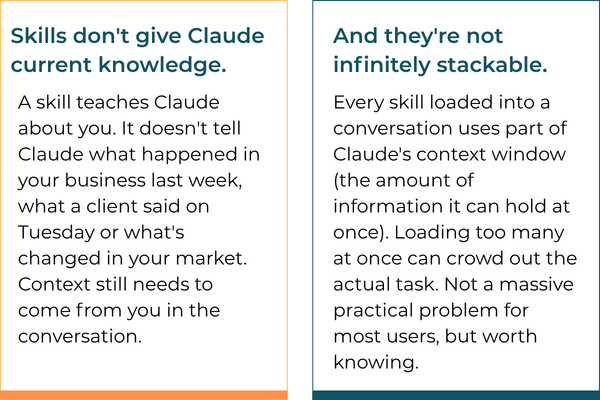
What you need to know before you build one
A few things most people don't realise until they're knee-deep in it.
Builder skills: when Claude builds Claude
Here's where it gets genuinely interesting.
Some skills are designed to produce other skills. You load a builder skill, Claude runs an interview, extracts what it needs from your answers, and produces a new skill file as the output. The skill builds the skill.
It's somewhere between a smart template and a simple agent. But the useful distinction for most people is this: some skills do things (write in your voice, apply your brand) and some skills make things (interview you and produce a new skill). The second type is a builder skill.
And yes, that means AI is being used to configure itself. Which is worth pausing on for a moment.
Where this becomes genuinely commercial
This is where skills stop being a productivity tool and start being something closer to infrastructure.
The core idea is that skills can encode your standard of good. Whatever excellent looks like in your business, whether that's a proposal, a client email, a piece of analysis or a sales conversation summary, you can capture the criteria and Claude applies them consistently, regardless of who on the team is doing the work.
A few ways businesses are using this well.
Onboarding and capability uplift. Instead of a new person spending months absorbing how things are done here, they have a skill that carries the institutional knowledge. The standard is accessible from day one.
Reducing the quality gap between people. Every team has range. Some people are naturally better at writing, communicating, structuring thinking. A well-built skill narrows that gap because everyone is working from the same reference point.
Making tacit knowledge explicit. This is the underrated one. Most of what makes a business good at what it does lives in people's heads and never gets written down. Building a skill forces the conversation: what does good actually look like here? That conversation has value, separate from the skill it produces.
Consistency across volume. As output scales, quality usually degrades. Skills help hold the standard when the team is producing more.
⚠️ The watch-out is important, though. Skills standardise what you tell them to standardise. If your definition of good is wrong or incomplete, you just produce consistently mediocre work faster. The quality of the skill is a direct reflection of the clarity of your thinking about your own standards. |
The induction nobody's doing
The businesses that will get the most from AI are not the ones with the most sophisticated prompts. They're the ones who invest in the induction. They take the time to articulate their standards, capture their knowledge, and build the context that lets AI actually work to their level.
Most people skip that step. Which means the opportunity, for the ones who don't, is significant.