

AI Literacy Nearly Doubles Return on AI Investments
By Sarah Williams
Organizations that train their people, not just buy the tools, are twice as likely to see real returns. Here's what the numbers actually show.
The Problem Nobody Talks About
There is a growing concern many businesses don't want to admit: they're spending serious money on AI and not seeing much back for it.
It's not because the tools are bad. Nor is it because AI is overhyped. The real reason behind the issue is that the people using those tools don't actually know how to use them well.
DataCamp and YouGov surveyed 517 business leaders across the US and UK in early 2026, and the findings were hard to ignore. Six in ten organizations said they had real AI and data skills gaps inside their teams. Leaders pointed to slower innovation, poor decisions, and falling behind competitors as the consequences. And yet, only 35% of those same organizations had a proper, company-wide training program in place.
They bought the software. They skipped the people part. Ooops!
What Happens When You Actually Train Your Team
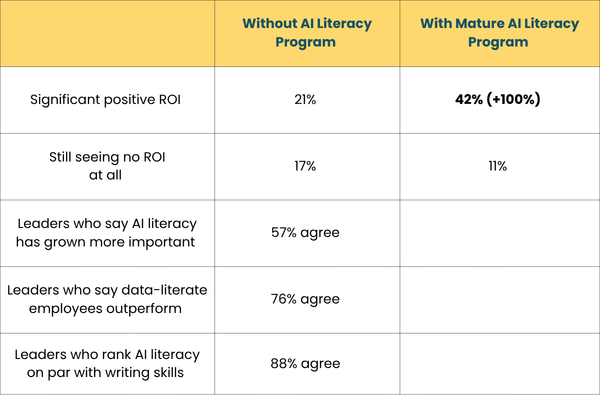
The difference is stark. Organizations without a structured AI literacy program? Only 21% reported significant ROI from their AI investments. Organizations with a mature training program? That number jumped to 42%, nearly double.
To put it plainly: if you're investing in AI but not investing in teaching your people how to use it, you're leaving money on the table. A lot of it.
"Companies are investing aggressively in AI tools without making the same investment in workforce capability. Make no mistake: that disconnect will limit the return on AI."
— Jonathan Cornelissen, Co-Founder & CEO, DataCamp
The Numbers at a Glance
A Real Company That Did It Right: Bayer
Bayer, the global pharmaceutical giant, didn't just roll out AI tools and hope for the best. They built what they called a Data Academy: a structured, multi-level program designed to build real AI and data fluency across the entire company. Not just the tech team or the blue-collar employees. Everyone.
The result? More than 90% of employees who went through the program came out with new ideas or found ways to improve their existing processes.
Let's stop and let that sink in. 90% of participants found ways to improve their existing processes. What else offers you the opportunity to gain efficiencies over 90% of your business?
What Actually Makes These Programs Work
As with most training, not all AI training is created equal. The companies that see real gains tend to do four things differently:
1. They make it relevant to the actual job. Generic AI courses don't move the needle. The best programs are designed around what HR, finance, marketing, and operations teams actually do day-to-day.
2. They get people doing, not just watching. Passive video courses are largely forgettable. Hands-on, project-based learning sticks and transfers into real work faster.
3. They train everyone, not just the tech people. When only the IT department knows how AI works, everyone else becomes a bottleneck. Company-wide literacy turns AI into a shared capability.
4. They treat it as ongoing, not one-and-done. AI is moving fast. The companies winning at this don't run a single training and call it done; they build a culture of continuous learning.
So, what does this mean for Your Business?
If you're a CEO, founder, or HR leader reading this, here's the honest takeaway: the gap between businesses that win with AI and businesses that don't appears to boil down to one thing: whether their people know how to use them.
The same 2026 report found that 59% of enterprise leaders admit there's still a skills gap in their organization, even the ones already spending on some form of AI training. The training exists, but it's not structured or broad enough to actually move the needle.
Buying better tools won't fix that. Training your people will.
Sources:


